🟠 Introduction
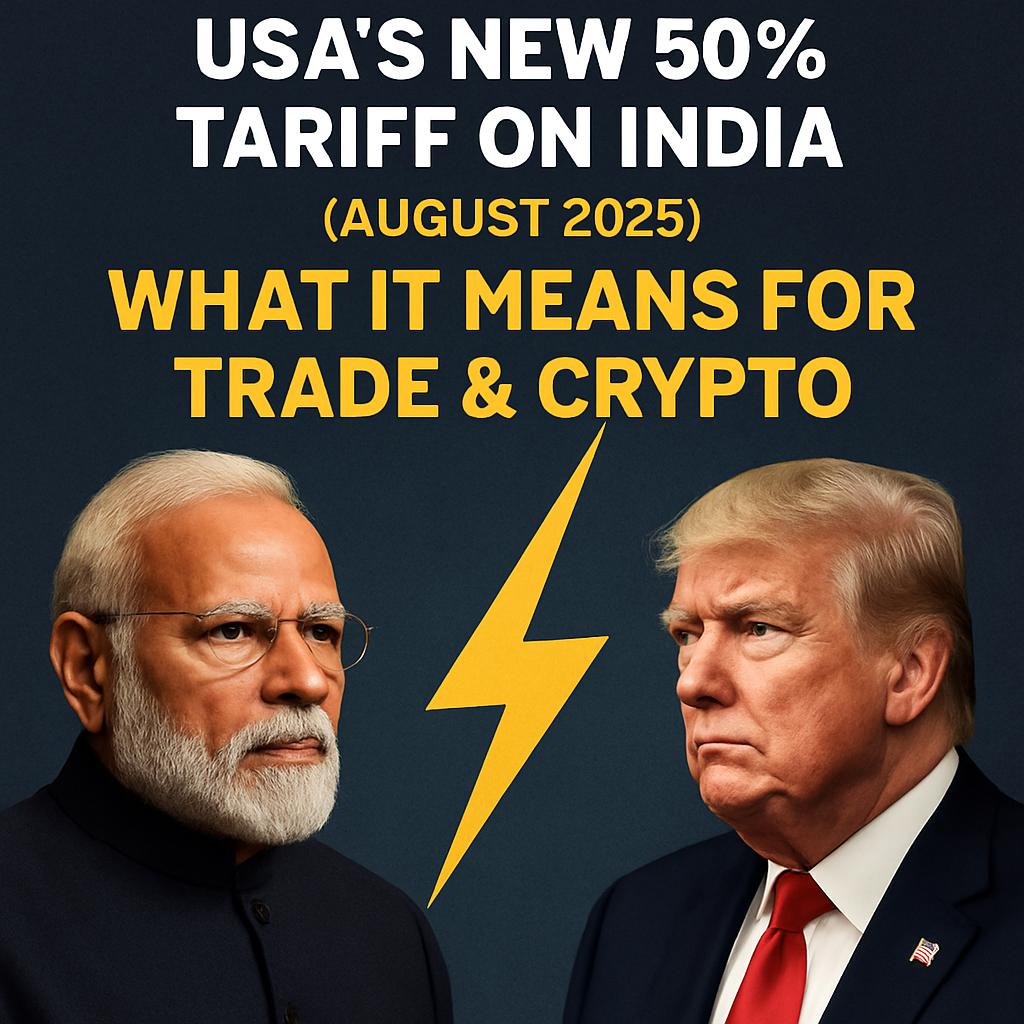
In a major escalation of global trade tensions, the United States announced a sharp increase in tariffs on select Indian exports in August 2025. The decision was implemented in two phases — an initial 25% tariff followed by an additional 25%, effectively raising duties to 50% on key Indian goods entering the U.S. market.
The move has triggered widespread concern across Indian export industries, financial markets, and policy circles. While traditional sectors such as steel, textiles, and auto components face immediate pressure, the ripple effects could extend far beyond manufacturing — influencing currency markets, investor sentiment, and even the adoption of alternative financial assets like cryptocurrencies.
This article explains the situation clearly and objectively:
- What the new U.S. tariffs are and why they matter
- Which Indian sectors are most exposed
- The broader economic implications for India
- And how global uncertainty could indirectly impact crypto markets
Note: This analysis is intended to explain potential economic and market implications in an objective manner. It does not represent political opinions or policy endorsements, and is meant solely for educational and informational purposes.
Periods of global economic uncertainty and policy shocks often influence investor behavior across asset classes, including digital assets and alternative financial markets.
https://thewealthholdings.in/why-90-percent-traders-lose-money/
🧾 What Is a Tariff — and Why Does It Matter?
A tariff is a tax imposed by a country on imported goods. When tariffs rise, imported products become more expensive in the destination country, often reducing demand and shifting buyers toward domestic or alternative suppliers.
Governments typically use tariffs to:
- 🛡️ Protect domestic industries from foreign competition
- 💰 Generate additional government revenue
- 🔁 Gain leverage in trade negotiations
While tariffs may benefit certain local producers, they often disrupt global supply chains, raise consumer prices, and create uncertainty in financial markets. In today’s interconnected economy, tariff decisions also influence currencies, capital flows, and investor behavior — not just physical trade.
Such macroeconomic disruptions can increase volatility in financial markets, making risk awareness and capital protection increasingly important for investors.
https://thewealthholdings.in/risk-management-in-trading/
🔍 The New U.S. Tariffs on India: Timeline & Details
The U.S. tariff increase on Indian imports has been structured in two distinct phases:
📦 Phase 1: 25% Tariff (Effective August 7, 2025)
From August 7, the U.S. imposed a 25% import duty on selected Indian goods, including:
- Steel and aluminum products
- Auto components
- Textiles and apparel
- Certain machinery and industrial equipment
U.S. officials cited the need to protect domestic manufacturers and address trade imbalances.
📦 Phase 2: Additional 25% Tariff (Effective August 27, 2025)
From August 27, an additional 25% tariff is scheduled to come into effect, raising the total tariff burden to 50% on these categories.
This effectively doubles the cost of importing many Indian goods into the U.S., significantly weakening their price competitiveness.
🏭 Indian Sectors Likely to Be Hit the Hardest
🏗️ Steel & Aluminum
India is a major exporter of steel and aluminum products to the U.S.
A 50% tariff makes these exports substantially more expensive, likely leading to:
- Reduced demand from U.S. buyers
- Pressure on margins for Indian producers
- Potential production slowdowns and employment stress
🚗 Auto Parts & Components
Indian auto component manufacturers supply a wide range of parts to U.S. automakers.
Higher tariffs may push buyers to source components from:
- Mexico
- Southeast Asia
- Domestic U.S. suppliers
This shift could particularly affect Tier-1 and Tier-2 Indian suppliers.
👕 Textiles & Apparel
Textiles are among India’s most labor-intensive export industries.
The tariff hike could result in:
- Order cancellations or renegotiations
- Buyers shifting sourcing to Bangladesh, Vietnam, or Cambodia
- Financial stress on MSMEs dependent on U.S. contracts
🛠️ Machinery & Capital Goods
Engineering goods and industrial machinery exports may face:
- Reduced order volumes
- Contract delays
- Increased pricing pressure
📉 Broader Impact on the Indian Economy
The U.S. is one of India’s largest trading partners. A sustained tariff shock of this scale could have wider economic consequences:
- 🔻 Export Growth Pressure: Lower export volumes reduce foreign exchange earnings
- 💸 Currency Impact: Reduced dollar inflows can weaken the Indian Rupee
- 🏭 Manufacturing Stress: Export-oriented industries may cut output or delay expansion
- ⚠️ MSME Vulnerability: Smaller exporters face higher risks of liquidity issues
- 📊 Market Sentiment: Trade uncertainty often leads to short-term volatility in equity markets
Some economists see this as a short-term disruption, while others warn of longer-term competitiveness challenges if alternative markets are not developed quickly.
Currency pressure and weakening confidence in traditional systems sometimes push investors to explore alternative stores of value, including cryptocurrencies.
https://thewealthholdings.in/what-is-crypto-trading-beginners-guide-2025/
🪙 Could This Boost Interest in Crypto Markets?
While tariffs directly affect traditional trade, their indirect impact on crypto markets is worth noting.
🔸 Global Uncertainty & Bitcoin Demand
Historically, periods of geopolitical or economic uncertainty — including trade disputes — tend to increase interest in alternative assets. Bitcoin is often viewed as a hedge during times of macro instability.
Historically, Bitcoin has benefited during periods of macro uncertainty as investors look for non-sovereign assets that operate outside traditional trade systems.
https://thewealthholdings.in/bitcoin-hits-new-all-time-high-2025/
🔸 Currency Pressure & Digital Assets
If trade tensions put pressure on the Indian Rupee, some investors may explore digital assets such as:
- Bitcoin
- Stablecoins
as alternative stores of value or cross-border settlement tools.
🔸 Cross-Border Payments & DeFi
Rising friction in traditional trade and payments can accelerate interest in:
- Decentralized finance (DeFi)
- Blockchain-based cross-border payment systems
While crypto is not a replacement for trade, uncertainty in legacy systems often increases experimentation with decentralized alternatives.
It is important to note that crypto markets do not move in isolation. While macro uncertainty can influence sentiment, digital assets remain volatile and are shaped by multiple factors including liquidity, regulation, and global risk appetite.
🧭 What Could Happen Next?
India has several strategic options:
- Diversifying export markets beyond the U.S.
- Strengthening regional trade ties in Asia, Africa, and Latin America
- Accelerating domestic manufacturing and consumption initiatives
Trade negotiations and diplomatic engagement may still alter the trajectory, but until clarity emerges, uncertainty will remain a key market driver.
🧠 Conclusion
The U.S. decision to raise tariffs on Indian exports to 50% by late August 2025 marks a significant moment in global trade relations. For Indian exporters, the challenges are immediate and tangible. For the broader economy, the effects will unfold over the coming quarters.
At the same time, history shows that periods of disruption often reshape capital flows and investor behavior. As traditional markets adjust, interest in alternative financial systems — including crypto assets — may gradually increase.
Shifts in global trade dynamics can also influence broader crypto market cycles, particularly during phases when capital rotates into high-growth digital assets.
https://thewealthholdings.in/altcoin-season-2025/
How governments, businesses, and investors respond in the coming months will play a critical role in shaping both trade dynamics and financial market trends.
📘 About The Wealth Holdings
The Wealth Holdings is a research-driven financial education platform focused on crypto, stock markets, and market psychology. Our content is designed to help readers understand market behavior, risk awareness, and long-term decision-making through structured analysis and educational insights.
We do not provide trading signals, investment advice, or guaranteed outcomes. All content published on The Wealth Holdings is intended strictly for educational and informational purposes, encouraging independent research and disciplined thinking in financial markets.
Time Is Greater Than Money.
🌐 Visit: https://thewealthholdings.in
⚠️ Disclaimer
This content is for educational and informational purposes only and should not be considered financial or investment advice. Trading in crypto and stock markets involves significant risk, and readers should conduct their own research before making any financial decisions.
Traiff war good info
Good
Great information