📌 Introduction 📊
Financial markets often appear unpredictable, but in reality, price follows a structured behavior. This structure is known as market structure. Understanding market structure helps traders and investors interpret how trends form, continue, and eventually reverse.
Market structure is not about predicting the future or finding perfect entries. It is about reading price behavior logicallyand understanding how buyers and sellers interact over time. This guide explains market structure in a clear, educational, and practical way, without indicators or signals.
Over time, observing price behavior across different market conditions helped clarify that structure is easier to understand in hindsight than in real time. This realization came from repeatedly misinterpreting trends before structure became clear.
🔍 What Is Market Structure?
Market structure refers to the sequence of price movements that show whether the market is:
- Trending upward
- Trending downward
- Moving sideways (range)
Price does not move randomly. It creates patterns of highs and lows, which reflect the ongoing battle between demand and supply.
This becomes clearer with experience, as repeated exposure to highs and lows gradually improves the ability to read price context.
At its core, market structure answers one simple question:
👉 Who is in control — buyers or sellers?
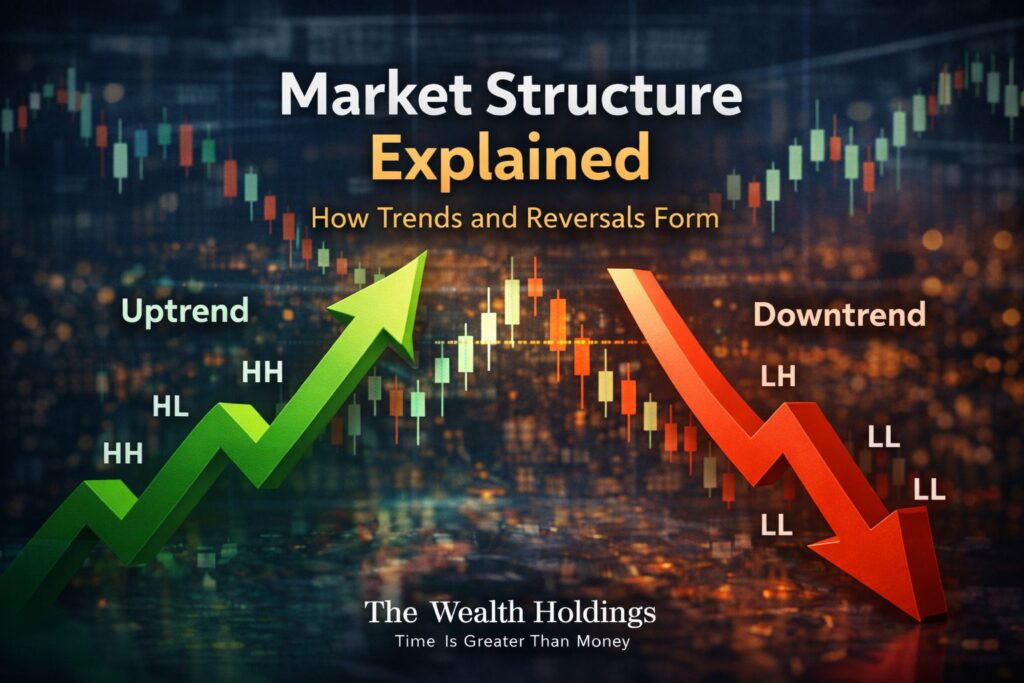
📈 Uptrend Explained: Higher Highs & Higher Lows
An uptrend forms when buyers consistently push price higher.
Characteristics of an Uptrend:
- Price makes Higher Highs (HH)
- Price makes Higher Lows (HL)
- Pullbacks are shallow and controlled
- Demand dominates supply
This structure shows that buyers are willing to step in at higher prices, keeping the trend intact. As long as higher lows hold, the bullish structure remains valid.
Uptrends often reflect strong market confidence, usually supported by liquidity and participation.
In practice, many uptrends appear obvious only after several higher lows have already formed, which highlights the importance of patience when reading structure.
Understanding market structure becomes easier when you also know how market liquidity drives price movement in financial markets.
https://thewealthholdings.in/understanding-market-liquidity/
📉 Downtrend Explained: Lower Highs & Lower Lows
A downtrend forms when sellers are in control.
Characteristics of a Downtrend:
- Price makes Lower Lows (LL)
- Price makes Lower Highs (LH)
- Rallies fail quickly
- Supply dominates demand
Here, sellers consistently overpower buyers. Any bounce is usually temporary unless the structure changes.
Downtrends often appear during periods of fear, uncertainty, or distribution.
Downtrends often become clearer after multiple failed rallies, rather than during the first signs of weakness.
➖ Ranging Market: When Price Moves Sideways
Not all markets trend. Sometimes price moves within a range.
Characteristics of a Range:
- Clear resistance at the top
- Clear support at the bottom
- No consistent higher highs or lower lows
- Liquidity builds on both sides
Ranges are important because they often precede strong breakouts or breakdowns. Understanding structure during ranges helps traders avoid overtrading and misinterpretation.
🔄 How Market Reversals Actually Form
Market reversals do not happen suddenly. They are processes, not single candles.
Common Signs of a Potential Reversal:
- Failure to make a new high in an uptrend
- Failure to make a new low in a downtrend
- Break of a key higher low or lower high
- Shift in momentum and participation
A reversal usually begins when the existing structure weakens and price fails to continue in the same direction.
Reversals usually appear gradual in real market conditions, making them easier to identify after confirmation rather than at the exact turning point.
🧠 Structure Shift vs Trend Change
Many traders confuse temporary pullbacks with reversals.
- A pullback respects the existing structure
- A structure shift breaks the previous pattern
- A trend change is confirmed only after structure realignment
Patience and observation are key. Structure changes become clear only with time.
💧 Role of Liquidity in Market Structure
Liquidity plays a critical role in shaping market structure.
Price often moves toward:
- Previous highs and lows
- Obvious support and resistance
- Areas where stop-loss orders exist
These movements help markets rebalance liquidity, which in turn influences trend continuation or reversal.
Understanding structure alongside liquidity provides clarity instead of confusion.
🧠 Market Structure & Trading Psychology
Market structure reflects human behavior.
- Fear causes early exits
- Greed causes late entries
- Overconfidence leads to poor risk decisions
By focusing on structure instead of emotions, traders reduce noise and improve consistency.
Understanding structure supports discipline and long-term thinking.
Market structure shifts are often influenced by trading psychology, as fear and greed impact how participants react to highs and lows.
https://thewealthholdings.in/trading-psychology-emotions-financial-markets/
⚠️ Common Mistakes Traders Make With Market Structure
- Forcing trends where none exist
- Ignoring higher time-frame structure
- Confusing consolidation with reversals
- Reacting emotionally instead of structurally
Market structure should be observed, not predicted.
Misreading market structure is one of the reasons why most traders lose money in crypto and stock markets.
https://thewealthholdings.in/why-90-percent-traders-lose-money/
🎯 Why Market Structure Matters for Long-Term Success
Market structure provides:
- Clarity
- Context
- Directional bias
- Risk awareness
It helps traders align with the market instead of fighting it. Over time, this leads to better decision-making and consistency.
A clear understanding of structure also supports better risk decisions, which is a core part of effective risk management in trading.
https://thewealthholdings.in/risk-management-in-trading/
🏁 Conclusion 🧩
Market structure is the foundation of price behavior. By understanding how trends and reversals form, traders gain a clear framework to analyze markets logically.
This knowledge does not promise profits, but it builds understanding, which is far more valuable in the long run.
A structured understanding of price behavior develops over time through observation, patience, and repeated market exposure.
📘 About The Wealth Holdings
The Wealth Holdings is a research-driven financial education platform focused on crypto, stock markets, and market psychology. Our content is designed to help readers understand market behavior, risk awareness, and long-term decision-making through structured analysis and educational insights.
We do not provide trading signals, investment advice, or guaranteed outcomes. All content published on The Wealth Holdings is intended strictly for educational and informational purposes, encouraging independent research and disciplined thinking in financial markets.
Time Is Greater Than Money.
🌐 Visit: https://thewealthholdings.in
⚠️ Disclaimer
This content is for educational and informational purposes only and should not be considered financial or investment advice. Trading in crypto and stock markets involves significant risk, and readers should conduct their own research before making any financial decisions.
[…] Understanding option price behavior becomes easier when you also understand how market structure forms trends and reversals in financial markets.https://thewealthholdings.in/market-structure-explained/ […]
Best leaning
Wealthholdings
Great learnings
[…] Fair Value Gaps should always be understood in the context of market structure, which explains how trends and reversals form over time.https://thewealthholdings.in/market-structure-explained/ […]