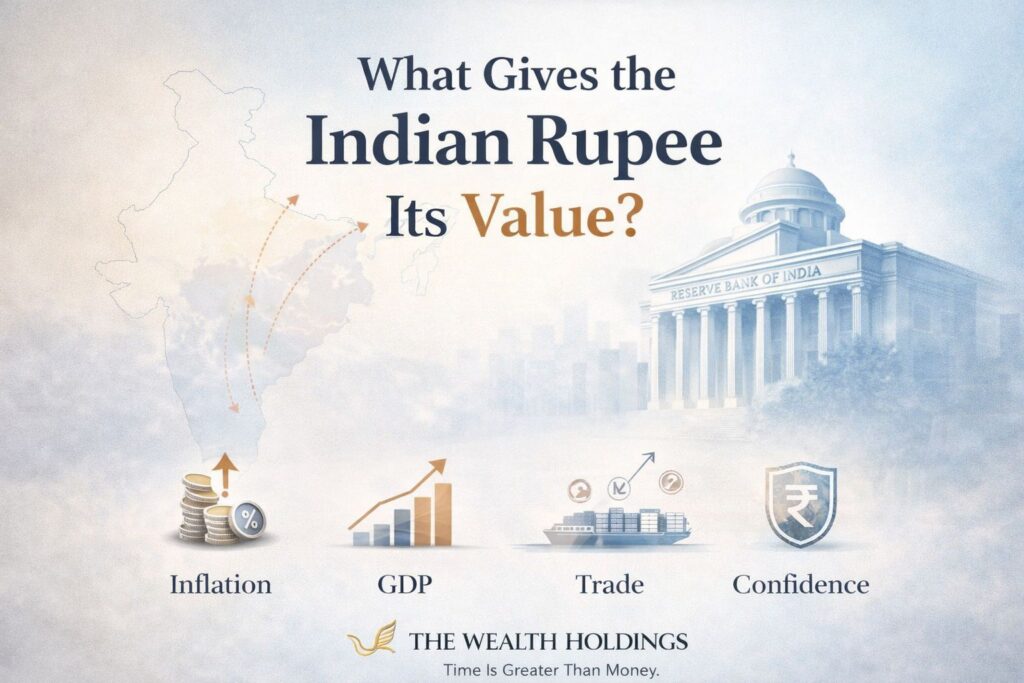
🧭 Introduction: Why Currency Value Matters
Every day, we use money without questioning its value.
We earn it, spend it, save it—but rarely stop to ask why a ₹100 note has meaning at all.
The Indian Rupee does not have value because it is printed on paper.
It has value because of trust, discipline, economic structure, and control.
Understanding what gives the Indian Rupee its value helps explain:
- why inflation happens
- why currencies rise or fall
- why printing money is never a shortcut to prosperity
This article explains the value of the Indian Rupee simply and honestly, without myths or oversimplification.
To fully understand why currency holds value, it helps to first understand how the Indian Rupee is created and controlledwithin India’s monetary system.
💡 First, What Does “Currency Value” Really Mean?
Currency value answers a basic question:
What can this money buy—today and tomorrow?
A currency is valuable when:
- it consistently buys goods and services
- people trust it for future use
- it is accepted widely within the economy
Value is not about how money looks.
It is about what stands behind it.
🏛️ Trust Is the Foundation of the Indian Rupee
The single most important factor behind any currency is trust.
People accept the Indian Rupee because:
- salaries are paid in it
- taxes are collected in it
- loans are settled in it
- businesses price goods in it
This trust is supported by institutions—especially the Reserve Bank of India—that ensure currency is not abused or overused.
Without trust, money becomes paper.
With trust, paper becomes value.
Currency value is deeply influenced by confidence and decision-making, which explains how trading psychology and emotions influence financial markets over time.
📊 Economic Output: Goods and Services Matter
Money derives strength from the economy it represents.
The Indian Rupee reflects:
- factories producing goods
- services being delivered
- people working and earning
- businesses creating value
When an economy produces more:
- money circulates efficiently
- purchasing power improves
- confidence increases
If money grows faster than production, value weakens.
If production grows steadily, value stabilizes.
⚖️ Controlled Supply: Why More Money Is Not Always Better
A common misunderstanding is that printing more money creates wealth.
In reality:
- excess money reduces value
- purchasing power falls
- inflation rises
The Indian Rupee maintains value because its supply is controlled, not unlimited.
Money is introduced:
- gradually
- based on economic needs
- with inflation risk in mind
This discipline protects the rupee from sudden loss of trust.
🧠 Inflation: The Silent Enemy of Currency Value
Inflation reduces what money can buy.
If prices rise faster than income:
- the rupee loses purchasing power
- savings lose real value
- economic confidence weakens
Inflation does not destroy money overnight.
It erodes value slowly but consistently.
This is why inflation control is central to preserving the rupee’s value.
🪙 Is the Indian Rupee Backed by Gold?
This is one of the most common questions—and myths.
🔹 The Short Answer
No. The Indian Rupee is not directly backed by gold.
🔹 The Reality
India follows a fiat currency system, meaning:
- money is not convertible into gold
- value comes from trust and economic strength
Gold still plays an important role:
- as part of reserves
- as a confidence stabilizer
- as a hedge in uncertainty
But gold does not limit or define how much money exists.
🌍 External Trade and Global Confidence
Currency value is also influenced by how the world views an economy.
Factors include:
- exports and imports
- foreign investment
- trade balance
- global demand for the currency
A country that:
- produces competitively
- trades reliably
- manages debt responsibly
builds external confidence—supporting its currency.
The rupee’s value is shaped both inside and outside India.
🔐 Discipline Over Shortcuts: The Real Strength
Strong currencies are not built through speed.
They are built through discipline.
This includes:
- controlled spending
- stable policy decisions
- long-term planning
- institutional independence
When discipline weakens, currency value follows.
This highlights why long-term currency stability depends on discipline, similar to how risk management focuses on capital protection rather than prediction.
🧩 What Does NOT Give the Rupee Its Value?
To be clear, the Indian Rupee’s value does not come from:
- printing more notes
- political promises
- short-term stimulus alone
- speculation
Currency value cannot be forced.
It must be earned and protected.
🧠 Simple Summary: What Gives the Indian Rupee Its Value?
The Indian Rupee holds value because of:
- trust in institutions
- productive economic activity
- controlled money supply
- inflation management
- domestic and global confidence
Each factor supports the others.
Remove one, and pressure builds on the system.
🧭 Conclusion: Value Is a Process, Not a Number
The Indian Rupee’s value is not fixed.
It is maintained every day through balance and responsibility.
Money works when:
- trust is preserved
- growth is real
- discipline is respected
Understanding this helps move beyond myths and builds realistic financial awareness.
📘 About The Wealth Holdings
The Wealth Holdings is a research-driven financial education platform focused on crypto markets, stock markets, commodities, and market psychology. Our goal is to help readers understand market behavior, risk awareness, and disciplined decision-making through structured educational content.
We do not provide trading signals, investment advice, or guaranteed outcomes. Our work encourages independent research, long-term thinking, and process-based learning.
Time Is Greater Than Money.
🌐 Visit: https://thewealthholdings.in
⚠️ Disclaimer
This content is for educational and informational purposes only and should not be considered financial or investment advice. Economic systems involve complexity and risk. Readers should conduct independent research or consult qualified professionals when required.
Excellent knowledge about Indian rupees