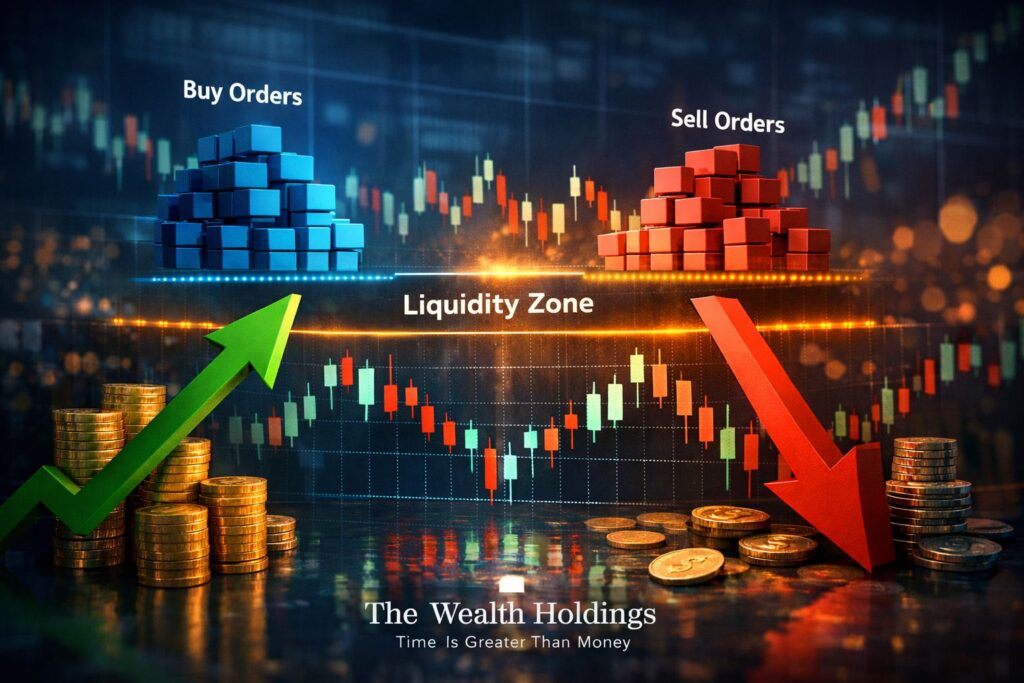
🔹 Introduction
Financial markets often appear complex, but at their core, price moves because of liquidity. Many traders focus heavily on indicators, patterns, or news, yet struggle to understand why price actually moves the way it does. This gap in understanding leads to confusion, emotional decisions, and inconsistent results.
Market liquidity explains how buyers and sellers interact, where orders accumulate, and why price accelerates or stalls at certain levels. Institutions and large participants rely on liquidity to execute orders efficiently, and their activity significantly influences market behavior.
This guide explains what market liquidity is, how it affects price movement, and why understanding liquidity is essential for anyone studying market structure, price action, or Smart Money Concepts (SMC).
With continued observation of price behavior, liquidity becomes easier to recognize after the move rather than during its formation.
🔹 What Is Market Liquidity? ⚖️
Market liquidity refers to the availability of buy and sell orders at different price levels. A market is considered liquid when large orders can be executed without causing extreme price changes.
Liquidity comes from:
- Pending buy orders
- Pending sell orders
- Stop orders placed by participants
- Limit orders resting in the market
High liquidity allows smooth price movement, while low liquidity can cause sharp and erratic moves. Liquidity is not fixed; it constantly shifts as participants place, modify, or cancel orders.
Understanding liquidity becomes easier when you know why price often moves toward obvious levels, which is one of the main reasons why most traders lose money in crypto and stock markets.
https://thewealthholdings.in/why-90-percent-traders-lose-money/
Liquidity is dynamic, which is why the same price level can behave differently at different times.
🔹 Why Liquidity Is Essential for Price Movement 💧
Price cannot move without liquidity. For a large participant to buy, someone else must be willing to sell. Institutions therefore seek areas where sufficient opposing orders exist.
Liquidity is commonly found:
- Above recent highs
- Below recent lows
- Around obvious support and resistance levels
- Near round numbers
These areas attract orders from retail traders, making them ideal zones for larger participants to transact.
🔹 How Institutions Use Liquidity 🧠
Large institutions cannot enter or exit positions randomly. Their order size requires deep liquidity pools to avoid excessive slippage.
Institutional behavior often involves:
- Executing trades in phases
- Targeting high-liquidity zones
- Avoiding thin market conditions
Instead of chasing price, institutions wait for liquidity to build. Once sufficient orders exist, price may move rapidly as large orders are filled.
This behavior explains why price often moves toward areas that appear obvious on the chart.
Liquidity-driven price movement is closely connected with trading psychology, as fear and greed often influence how traders react near highs and lows.
https://thewealthholdings.in/trading-psychology-emotions-financial-markets/
This process often appears deliberate in hindsight, even though it unfolds gradually in real market conditions.
🔹 Liquidity and Market Structure 🧱
Market structure describes how price forms highs and lows over time. Liquidity plays a key role in shaping this structure.
In an uptrend:
- Liquidity tends to accumulate below higher lows
- Breaks above highs often occur after liquidity is built
In a downtrend:
- Liquidity builds above lower highs
- Breaks below lows occur after sufficient orders accumulate
Understanding this relationship helps traders interpret price movement without relying on indicators.
🔹 Buy-Side and Sell-Side Liquidity 🔁
Liquidity is often categorized into two broad types:
Buy-Side Liquidity
- Found above swing highs
- Contains stop orders from sellers
- Often targeted during upward price moves
Sell-Side Liquidity
- Found below swing lows
- Contains stop orders from buyers
- Often targeted during downward moves
Price frequently moves toward these areas because they provide the orders needed for larger transactions.
🔹 Liquidity vs Support and Resistance 📊
Traditional support and resistance levels represent areas where price previously reacted. From a liquidity perspective, these levels are important because they attract orders.
When many traders place orders around the same level:
- Liquidity increases
- Price may briefly move beyond the level
- Sharp reactions can follow
This does not mean support and resistance are invalid. It means their effectiveness is influenced by how much liquidity exists around them.
The reaction at these levels depends less on the level itself and more on the concentration of orders around it.
🔹 Why Price Moves Quickly After Consolidation ⏱️
Periods of consolidation often confuse traders. Price appears inactive, volume may decrease, and direction becomes unclear.
From a liquidity perspective:
- Orders accumulate during consolidation
- Both buyers and sellers build positions
- Liquidity increases within a narrow range
Once sufficient liquidity exists, price may expand rapidly as large participants execute orders. This explains why breakouts often follow extended ranges.
Once accumulated orders are absorbed, price expansion tends to occur rapidly rather than gradually.
🔹 Liquidity and Volatility 📉
Volatility and liquidity are closely connected. Sudden increases in volatility often occur when price reaches areas with dense liquidity.
Low liquidity environments may result in:
- Wide spreads
- Erratic price movement
- Increased slippage
High liquidity environments support:
- Cleaner price action
- More efficient order execution
- Structured movement
Understanding this relationship helps traders avoid confusing volatility with randomness.
🔹 Common Misconceptions About Liquidity ❌
Several misconceptions exist around liquidity:
- Liquidity is not manipulation
- Liquidity does not guarantee direction
- Liquidity zones are not entry signals
Liquidity explains where price is likely to move, not how to trade it. Treating liquidity as a prediction tool often leads to misinterpretation.
Misunderstanding liquidity is also part of common crypto trading mistakes beginners make, especially when traders assume price movement is random.
https://thewealthholdings.in/crypto-trading-mistakes-beginners/
🔹 Liquidity in Different Market Conditions 🌍
Liquidity behaves differently across market environments:
- Trending markets: Liquidity shifts in the direction of the trend
- Ranging markets: Liquidity builds on both sides of the range
- News-driven markets: Liquidity may temporarily disappear
Recognizing the context is essential when analyzing price movement through a liquidity lens.
🔹 Why Understanding Liquidity Improves Market Awareness 🧠
Understanding liquidity enhances market awareness by shifting focus from indicators to behavior. Traders become more attentive to how price reacts near highs, lows, and key levels.
This awareness:
- Reduces emotional decision-making
- Improves patience
- Encourages objective analysis
Liquidity-based thinking supports a more structured and disciplined approach to market observation.
Market liquidity also plays a major role during high volatility phases, which can be seen clearly during sharp market swings.
https://thewealthholdings.in/indian-market-august-7-stock-swing/
🔹 Conclusion
Market liquidity is a fundamental driver of price movement in financial markets. It explains why price moves toward certain levels, why breakouts occur after consolidation, and why volatility increases near highs and lows.
Understanding liquidity does not provide shortcuts or guarantees. Instead, it offers clarity into market behavior and helps traders interpret price movement more objectively. By focusing on liquidity, traders shift from reactive thinking to informed observation — an essential step toward long-term market understanding.
Liquidity provides context for price movement, helping explain behavior rather than predict outcomes.
📘 About The Wealth Holdings
The Wealth Holdings is a research-driven financial education platform focused on crypto, stock markets, and market psychology. Our content is designed to help readers understand market behavior, risk awareness, and long-term decision-making through structured analysis and educational insights.
We do not provide trading signals, investment advice, or guaranteed outcomes. All content published on The Wealth Holdings is intended strictly for educational and informational purposes, encouraging independent research and disciplined thinking in financial markets.
Time Is Greater Than Money.
🌐 Visit: https://thewealthholdings.in
⚠️ Disclaimer
This content is for educational and informational purposes only and should not be considered financial or investment advice. Trading in crypto and stock markets involves significant risk, and readers should conduct their own research before making any financial decisions.
Good
Great blog .
Very helpful .
[…] Understanding market structure becomes easier when you also know how market liquidity drives price movement in financial markets.https://thewealthholdings.in/understanding-market-liquidity/ […]
[…] Aggressive price movement that creates Fair Value Gaps is closely connected with market liquidity, which explains why price accelerates after orders are consumed.https://thewealthholdings.in/understanding-market-liquidity/ […]
Nice
[…] The control of currency and liquidity plays a critical role in maintaining financial stability, which is closely connected to how liquidity flows through financial markets. […]
[…] This explains why markets often change direction without visible news.👉 https://thewealthholdings.in/understanding-market-liquidity/ […]